
The BEST Cinnamon Rolls
About this recipe
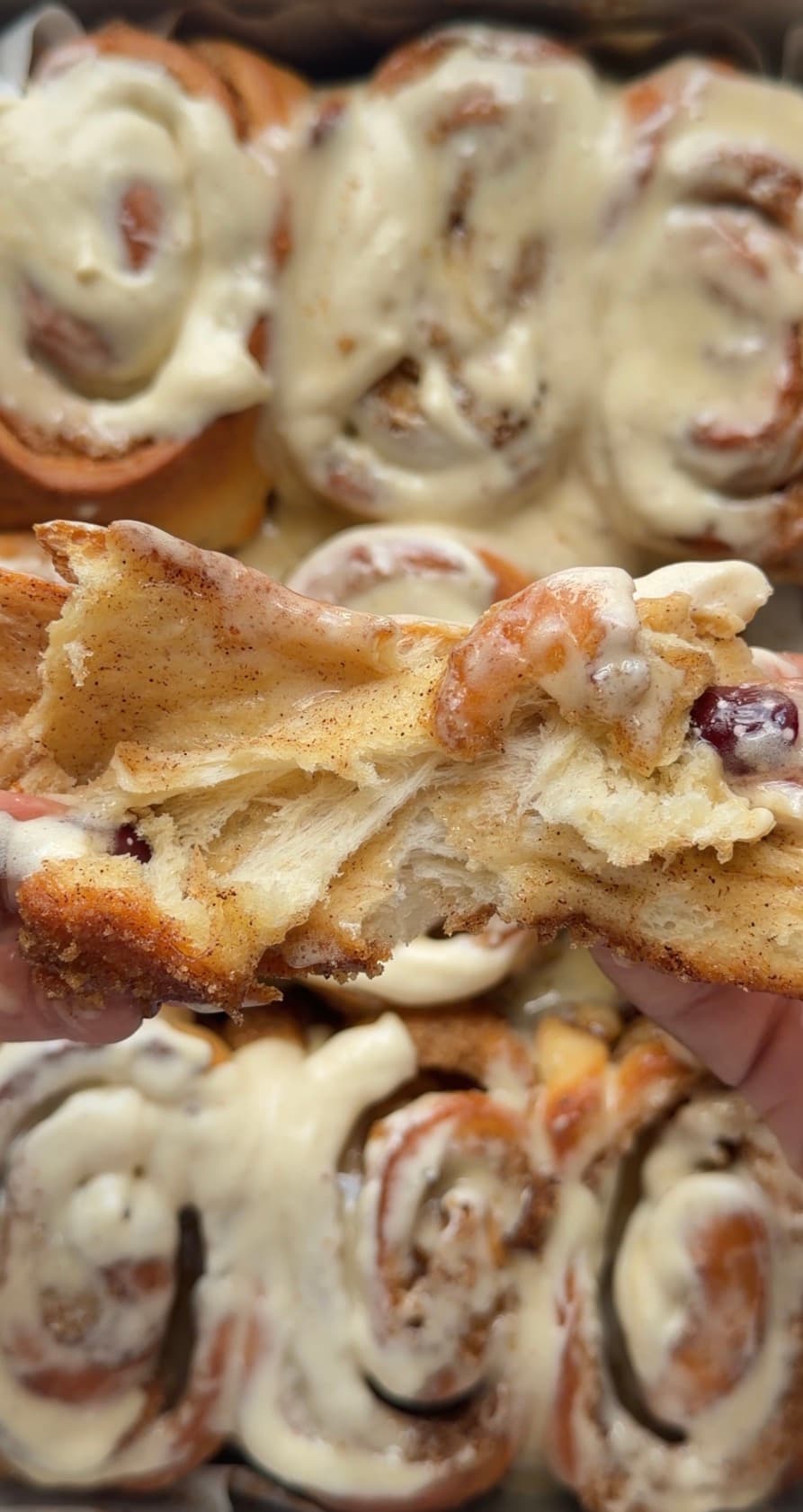
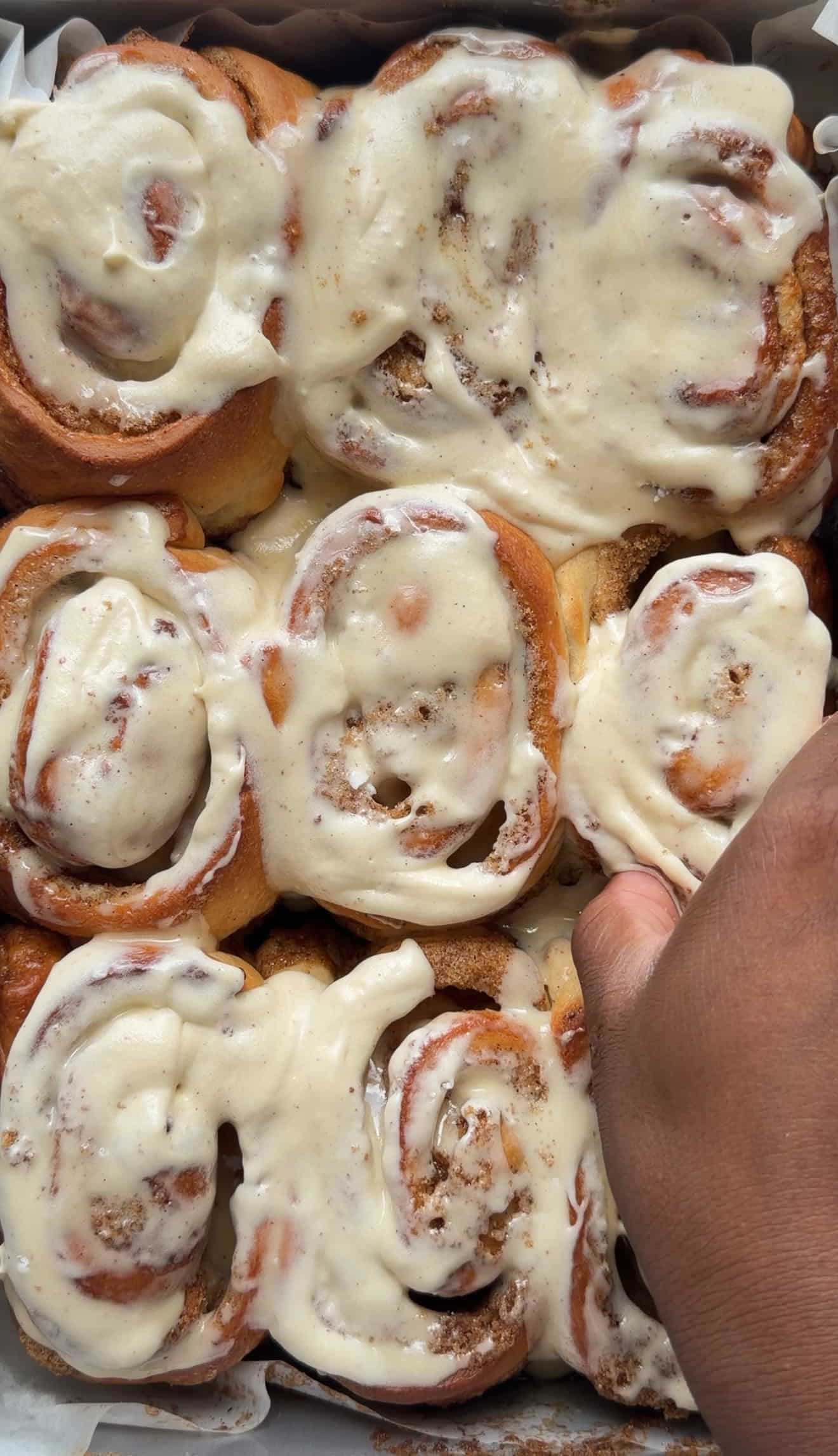
There are cinnamon rolls, and then there are proper cinnamon rolls. The kind that are big, fluffy, incredibly soft and filled with buttery cinnamon sugar, with a centre that practically melts in your mouth. These are exactly that, and I genuinely think they might be the best homemade cinnamon rolls you'll ever make.
I've made my fair share of cinnamon rolls over the years, and if there's one thing I've learnt, it's that a good cinnamon roll is all about the dough. You want something soft and pillowy, but with enough structure to hold all that delicious cinnamon filling. Nobody wants a dry, dense cinnamon roll, especially when you've spent over three hours making them!
That's why I've made a few changes to my usual cinnamon roll recipe, including my new favourite baking technique: tangzhong. Alongside sour cream, plenty of butter and a generous brown sugar cinnamon filling, this simple addition makes the biggest difference to the texture.
The result? Homemade cinnamon rolls that are beautifully soft when freshly baked and, even better, stay soft the following day.
Whether you're making these for a weekend breakfast, a cosy autumn baking session or simply because you're craving something sweet, this is a cinnamon roll recipe you'll want to make again and again.
What Makes These Cinnamon Rolls So Soft?
The secret to these extra-soft cinnamon rolls is a combination of three ingredients: tangzhong, sour cream and butter.
Each plays an important role in creating that fluffy, tender texture we're after.
The tangzhong helps the dough retain moisture, the sour cream adds richness and tenderness, and the butter creates a beautifully soft, enriched dough.
Together, they make cinnamon rolls that are light and fluffy rather than heavy or bread-like.
And although these cinnamon rolls taste like something you'd buy from a really good bakery, they're surprisingly straightforward to make at home.
What Is Tangzhong and Why Should You Use It?
If you've followed my baking recipes for a while, you'll know I love finding little techniques that make a big difference. My latest obsession is tangzhong, and I don't think I'll be making cinnamon rolls without it anytime soon.
Tangzhong is a traditional Asian bread-making technique that involves cooking a small amount of flour with liquid, usually milk or water, until it forms a thick, smooth paste.
For this recipe, we're using just three ingredients: bread flour, whole milk and water.
It sounds almost too simple to make a difference, but trust me, this little mixture packs such a punch.
When the flour and liquid are heated together, the starches in the flour gelatinise, allowing them to absorb and hold onto more moisture. Once added to your dough, this helps create a softer, fluffier texture that stays tender for longer.
And that's exactly what we want from a cinnamon roll.
Why Tangzhong Makes Cinnamon Rolls Better the Next Day
Now, I don't know about you, but as much as I love cinnamon rolls, I can't always finish 12 of them in one sitting.
And while cinnamon rolls are undeniably at their best freshly baked, the real disappointment comes the next morning when you go back for another one, only to discover it's become hard and dry.
This is where tangzhong really shines.
Because the dough retains more moisture, the cinnamon rolls stay noticeably softer for longer, even after they've cooled completely. It doesn't mean they'll stay freshly baked forever, but it makes a huge difference compared with a traditional cinnamon roll dough.
A quick reheat and they're almost as good as when they first came out of the oven.
Why I Add Sour Cream to My Cinnamon Roll Dough
If there's one ingredient you'll notice appearing in quite a few of my cake and baking recipes, it's sour cream.
It's genuinely one of my favourite ingredients for creating a soft, tender texture, and these cinnamon rolls are no exception.
Sour cream adds richness and moisture to the dough, while its acidity helps contribute to that beautifully tender crumb.
It also gives the rolls a subtle tanginess that balances the sweetness of the cinnamon sugar filling without making them taste sour.
Combined with the tangzhong, it creates a dough that's incredibly soft without feeling overly wet or underbaked.
If you enjoy baking with sour cream, you'll know just how much of a difference it can make to the finished texture.
An Easy One-Bowl Cinnamon Roll Dough
One of my favourite things about this recipe is how simple the actual dough-making process is.
Once you've prepared your tangzhong and allowed it to cool, you can pretty much pop all your dough ingredients into your stand mixer and let it do the hard work.
There's no complicated mixing process or endless bowls to wash up.
You'll be combining bread flour, warm milk, sugar, yeast, sour cream, softened butter, eggs, vanilla, salt and your cooled tangzhong.
The important thing is to make sure everything is mixed thoroughly and the dough has developed enough gluten before you leave it to rise.
Which brings me to one of the most important tips in this entire recipe.
The Windowpane Test: The Secret to Perfect Cinnamon Roll Dough
There's a reason some bread recipes tell you to knead for 10 minutes while others say 15 or even 20.
The truth is, the exact mixing time isn't nearly as important as the condition of your dough.
Different mixers, flour brands and even room temperatures can affect how quickly gluten develops.
That's why I always recommend using the windowpane test rather than relying entirely on a timer.
How to Do the Windowpane Test
Take a small piece of your kneaded dough and gently stretch it between your fingers.
If the dough has developed enough gluten, you should be able to stretch it into a thin, almost translucent membrane without it immediately tearing. You should practically be able to see light through it, just like a windowpane.
If the dough tears quickly or feels rough, it needs more kneading.
Continue mixing for a few more minutes before testing again.
This is particularly important for enriched doughs like cinnamon rolls because ingredients such as butter, eggs and sour cream can slow down gluten development.
A properly kneaded dough gives you that beautiful, fluffy structure rather than cinnamon rolls that are dense or overly doughy.
Make Sure Your Yeast Is Alive
Imagine spending hours preparing your cinnamon rolls, only to discover that your dough hasn't risen.
Unfortunately, this is one of the most common things that can go wrong when making homemade cinnamon rolls.
Before you begin, it's worth checking that your yeast is active, especially if you've had it sitting in your cupboard for a while.
To test active dry yeast, mix a small amount with warm water or milk and a pinch of sugar. Leave it for around 5–10 minutes.
You should notice bubbles forming on the surface and a foamy appearance. This tells you the yeast is alive and ready to help your dough rise.
If nothing happens, your yeast may no longer be active.
Also, make sure your milk isn't too hot. Yeast loves warmth, but excessive heat can kill it, preventing your dough from rising properly.
How to Cut Perfect Cinnamon Rolls With Dental Floss
Here's a little trick that makes such a difference to the appearance of your cinnamon rolls: use unflavoured dental floss instead of a knife.
When you slice soft cinnamon roll dough with a knife, you're often pushing down on the dough, which can squash those beautiful spirals you've spent time creating.
Dental floss gives you a much cleaner cut.
Simply slide a piece of unflavoured dental floss underneath your rolled dough, cross the ends over the top and pull in opposite directions.
The floss slices straight through without compressing the dough.
You'll be left with beautifully round cinnamon rolls and clearly defined cinnamon sugar swirls.
It's such a simple trick, but once you try it, you'll probably never go back to using a knife.
How to Keep Cinnamon Rolls Soft and Gooey When Reheating
As much as I love a freshly baked cinnamon roll, sometimes you just want to enjoy one the following morning without making an entirely new batch.
My favourite trick for reheating cinnamon rolls is to add one teaspoon of double cream before warming them.
Place your cinnamon roll in a microwave-safe dish, drizzle over the double cream and microwave in short bursts until warmed through.
The cream adds a little extra moisture and richness, helping soften the roll and bring back some of that gooey texture.
Just be careful not to overheat it, as this can make the dough tough.
Thanks to the tangzhong, these cinnamon rolls already retain moisture beautifully, so you don't need much to bring them back to life.
Making cinnamon rolls from scratch might take a little patience, but I promise the results are worth it.
Between the tangzhong, sour cream and properly developed dough, every part of this recipe has been designed to give you the softest, fluffiest cinnamon rolls possible.
My biggest advice? Don't rush the process. Make sure your yeast is active, knead until your dough passes the windowpane test, and give the rolls enough time to rise before baking.
Because when you've spent hours making homemade cinnamon rolls, you deserve ones that are absolutely delicious.
And once you've tried this tangzhong cinnamon roll recipe, I have a feeling it'll become your new favourite too.
More Baking Recipes You'll Love
If you love these homemade cinnamon rolls, there are plenty more delicious bakes to try on Food by Remi.
For another soft, fluffy bake, try my Chimmichurri Foccacia which uses a technique to create beautifully tender bread.
If you're in the mood for something sweet, my Crème Brûlée Snickerdoodle Cookies combine warming cinnamon with a creamy vanilla custard centre and caramelised sugar topping.
You might also love my Brown Butter Chocolate Cake, or browse my cookie recipes for more comforting homemade treats.
Ingredients
Tangzhong
- 25g bread flour
- 70ml whole milk
- 70ml; water
Dough
- 500g bread flour
- 30ml whole milk, warmed
- 75g granulated sugar
- 15g active dry yeast
- 100g sour cream, room temperature
- 100g salted butter, very soft
- 2 large eggs, room temperature
- 5g vanilla bean paste
- 6g salt
- All of the cooled tangzhong
Filling
- 175g salted butter, softened
- 240g light brown sugar
- 8g cinnamon
- 4g vanilla extract
Brown Butter Cream Cheese Frosting
- 100g cream cheese
- 50g butter
- 300g icing sugar
Ingredients
Instructions
- Start by making the brown butter for the frosting. Add 50g butter to a light-coloured saucepan over medium heat. Allow it to melt, stirring occasionally as it begins to foam and bubble. Continue cooking until the milk solids turn golden brown and the butter develops a rich, nutty aroma. Immediately transfer to a heatproof bowl, including the browned milk solids, and allow to cool completely until soft and spreadable but no longer liquid.
- Prepare the tangzhong by combining 25g bread flour, 71g whole milk and 71g water in a small saucepan. Whisk until smooth, then place over medium-low heat, stirring continuously until the mixture thickens into a smooth paste, reaching approximately 65°C. Transfer to a bowl, cover the surface with cling film and allow to cool completely.
- To bloom the yeast, combine 30ml warm whole milk, 15g active dry yeast and 12g granulated sugar (taken from the total 75g) in a small bowl. Stir gently and leave for 5–10 minutes until the mixture becomes foamy and bubbly. This indicates that the yeast is active. If the mixture doesn't foam, check that your yeast is still active before proceeding.
- In the bowl of a stand mixer fitted with a dough hook, add 500g bread flour, the remaining 63g granulated sugar, 100g sour cream, 100g very soft salted butter, 2 large eggs, 5g vanilla bean paste, 6g salt, all of the cooled tangzhong and the bloomed yeast mixture.
- Mix on a low speed for 2–3 minutes until the ingredients come together to form a rough dough. Increase to a medium-low speed and knead for approximately 10–15 minutes until the dough becomes smooth, elastic and slightly tacky. The dough should begin pulling away from the sides of the bowl.
- Check the gluten development using the windowpane test. Take a small piece of dough and gently stretch it between your fingers. You should be able to stretch it thin enough to see light through it without tearing. If it breaks easily, continue kneading for a few more minutes and test again.
- Shape the dough into a smooth ball and transfer to a lightly greased bowl. Cover with cling film or a clean tea towel and leave in a warm place to prove for approximately 1–2 hours, or until doubled in size.
- While the dough is proving, prepare the cinnamon filling. In a medium bowl, combine 175g softened salted butter, 240g light brown sugar, 8g ground cinnamon and 4g vanilla extract. Mix until smooth and fully incorporated, creating a thick, spreadable paste. Set aside at room temperature.
- Once the dough has doubled in size, gently punch it down to release the air and transfer it to a lightly floured work surface. Roll the dough into a large rectangle, approximately 45 × 35cm, keeping the thickness as even as possible.
- Using an offset spatula, spread the cinnamon sugar filling evenly over the dough, reaching almost to the edges. Starting from one of the longer sides, tightly roll the dough into a log, keeping the roll as even as possible.
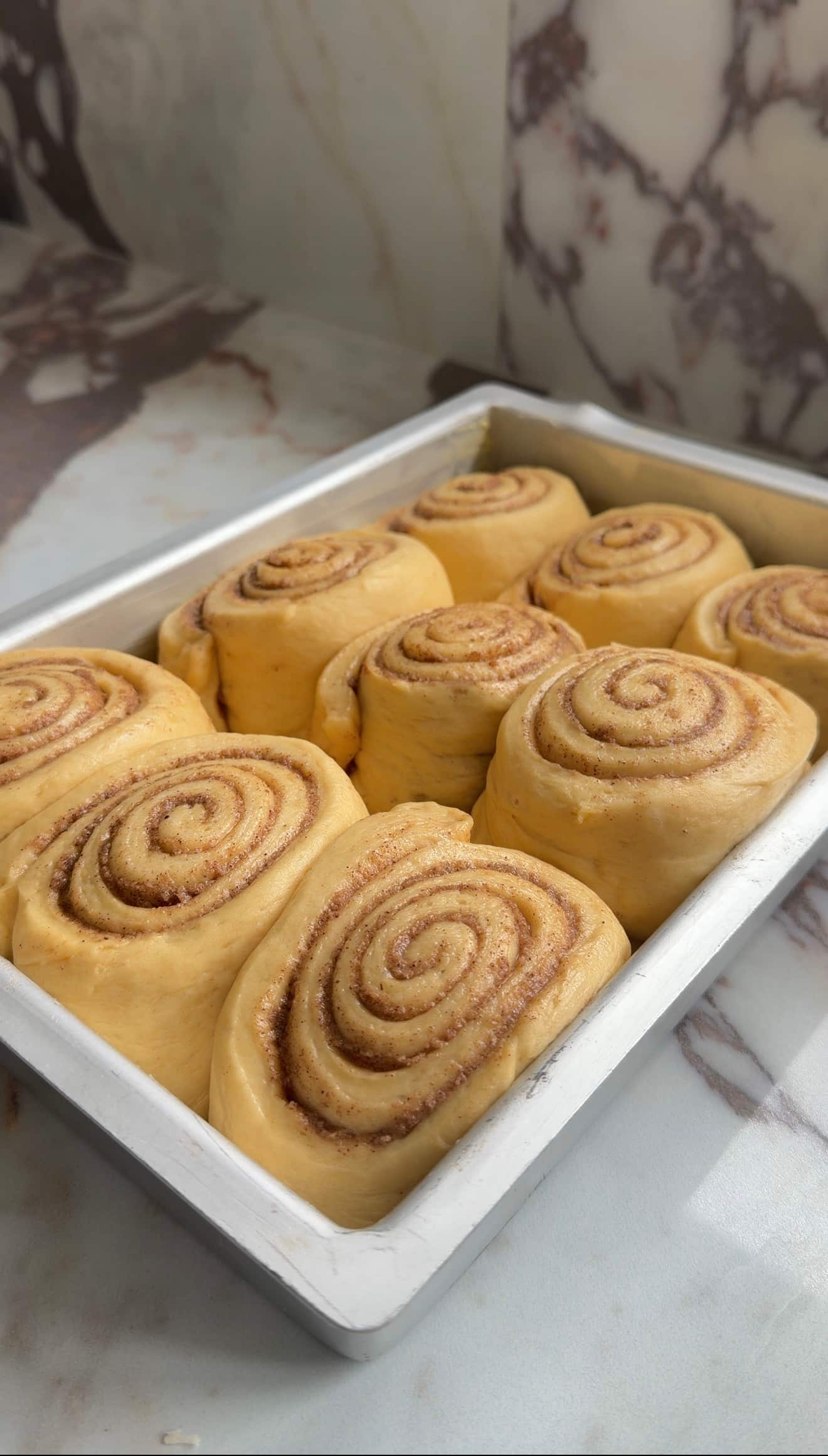
- Using unflavoured dental floss, cut the dough into 12 equal-sized cinnamon rolls. Slide the floss underneath the log, cross the ends over the top and pull in opposite directions to create a clean cut without squashing the dough.
- Arrange the cinnamon rolls in a lightly greased or lined baking dish, leaving a little space between each one. Cover loosely and leave to prove for a further 45–75 minutes, or until noticeably puffy and almost doubled in size.
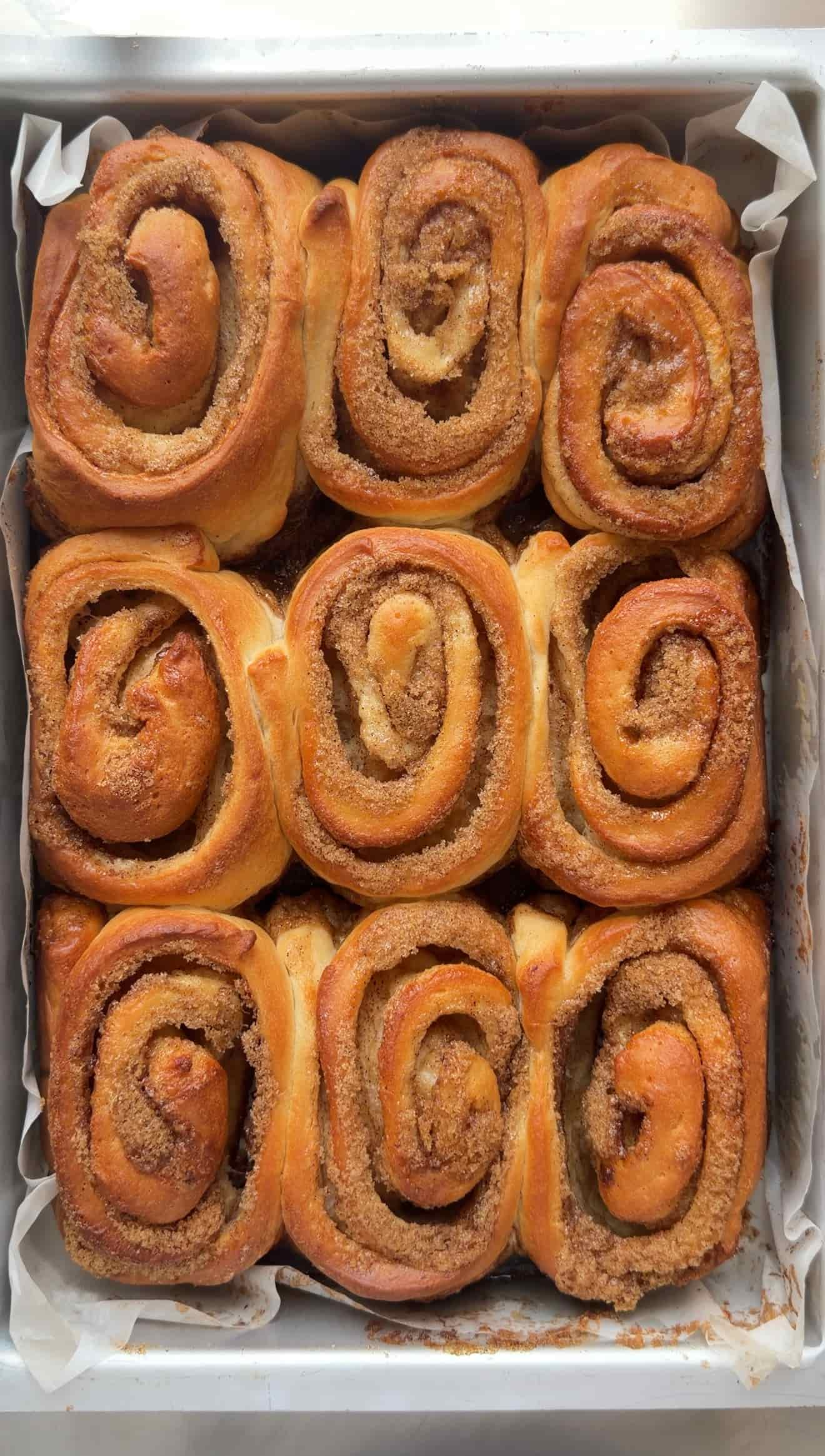
- Towards the end of the second prove, preheat your oven to 180°C conventional (160°C fan). Once the cinnamon rolls have risen, bake on the middle shelf for 25–35 minutes, or until lightly golden brown and cooked through. If the tops begin to brown too quickly, loosely cover with aluminium foil.
- While the cinnamon rolls are baking, finish the brown butter cream cheese frosting. Beat the cooled brown butter with 100g cream cheese until smooth and creamy. Gradually sift in 300g icing sugar, mixing on a low speed initially, then increase the speed and beat until light, smooth and fluffy.
- Remove the cinnamon rolls from the oven and allow them to cool in the baking dish for approximately 10–15 minutes. While they're still warm, generously spread the brown butter cream cheese frosting over the tops, allowing it to soften and melt slightly into the cinnamon swirls.
- Serve the cinnamon rolls warm for the best soft, fluffy and gooey texture. To reheat any leftovers, add approximately 1 teaspoon of double cream around each roll and microwave in short 10–15-second intervals until warmed through. Store frosted leftovers in an airtight container in the fridge for up to 3–4 days.

Hi, I'm Remi
Follow me on socials to stay connected!
Pin this Recipe
More like this


More recipes like this
Tempted by something else?


Work with me, or ask me a question!
I'm all about teaming up with cool new brands that align with my audience and make cooking awesome meals a breeze. Drop me a line, and let's cook up some exciting plans together!

Want free recipes and insider knowledge in your inbox?
Subscribe Below!